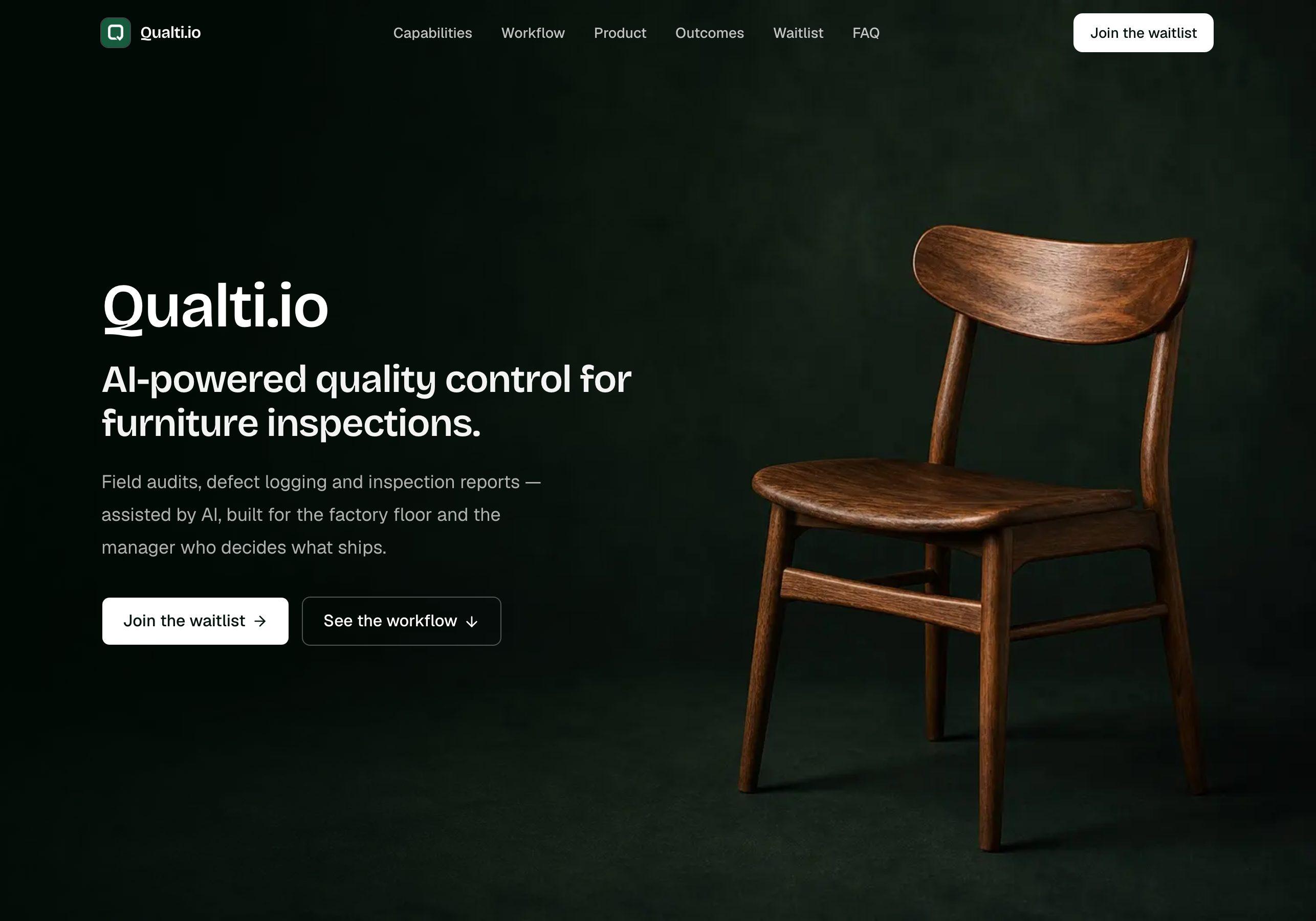
Qualti.io
An open-source, API-first quality inspection platform for furniture manufacturing.
- Role
- Product design and full-stack engineering
- Context
- Independent open-source project
- Category
- Open-source SaaS
- Year
- 2026
The problem
Furniture quality control happens at many stages: incoming material, in-line production, pre-shipment, container loading. Every buyer brings its own checklist, tolerances and photo requirements. Hardcoded checklists break the first time a buyer changes a tolerance, and general-purpose inspection platforms take real effort to bend into furniture workflows.
The people doing the work, from factory QC teams to third-party inspectors and buying houses, need something they can configure themselves and connect to the systems they already run.
The product
Qualti.io is an open-source, API-first quality inspection platform, starting with furniture. A quality team builds an inspection template out of sections and checkpoints, previews it, publishes it and runs inspections against it. Organizations, sites and memberships keep each company's data separate, and the API is a first-class surface rather than an afterthought, so an ERP can eventually create inspections and receive results.
The current focus is the Furniture Inspection Template Studio: choose a default or blank template, build it, configure checkpoints, preview, publish, and run.
My contribution
Qualti is a solo project. I wrote the product specification and the architecture, data-model, API, security and template-system documents before writing features, then built the NestJS API, the Prisma schema and the Next.js application on top of them.
Technical approach
The repository is a pnpm monorepo with three parts: apps/web (Next.js), apps/api (NestJS with Prisma on PostgreSQL) and packages/config, which holds the shared ESLint and TypeScript configuration.
The API is split into modules that mirror the domain: auth, users, organizations, memberships, sites, templates, audit and health. Templates are modelled as InspectionTemplate → TemplateVersion → TemplateSection → TemplateItem, with item types such as pass/fail, text and numeric.
On the web side, React Query owns server state, React Hook Form and Zod handle the form-heavy template builder, and the interface is built from Radix primitives styled with Tailwind CSS.
Engineering decisions
- Published template versions are immutable. A version moves from draft to published and never changes after that. Inspections point at a specific version, so editing a template can't silently rewrite the history of inspections already performed against it.
- Tenant isolation is explicit. Every business entity carries its organization, and the security model starts from deny-by-default. Broken object-level authorization, where one company guesses another company's IDs, is named in the threat model rather than left to chance.
- Roles match the real job. Owner, admin, reviewer and inspector are separate roles, so an inspector doesn't automatically get organization administration.
- Audit events from day one. Changes are recorded as audit events indexed by organization and time, which an inspection product needs long before it needs analytics.
- Template definitions stay framework-independent. The canonical format doesn't depend on React, NestJS or Prisma, so the same template can later travel to a mobile app, an import/export file or an SDK.
- AGPL-3.0. Anyone can self-host and modify Qualti, and anyone running a modified version as a service must share those changes.
Challenges and trade-offs
The hardest balance is flexibility against validation. The more a template can express, the harder it is to validate responses and compute results consistently, so the template format carries its own schema version and can evolve without breaking old inspections.
Furniture-first is a deliberate constraint. A generic workflow engine would be easier to pitch and much harder to make good, so product decisions favour furniture workflows first and generalise later. Templates also come before workflow automation: if building and running a template isn't excellent, nothing layered on top will be.
Writing the documentation first slowed the first commits, but it settled questions such as tenancy, versioning and immutability before any code depended on the answers.
Outcomes
- Open source under AGPL-3.0, with a public site and waitlist at qualti.io (opens in a new tab).
- A documented architecture, data model, API design, security model and template system that contributors can read before touching code.
- API modules for authentication, organizations, memberships, sites, templates, users and audit events.
- In active development, with the template studio as the current milestone.
Technologies used
- Next.js
- NestJS
- Prisma
- PostgreSQL
- TypeScript
- React Query
- Zod
- Tailwind CSS